
California Wildfires: A Haunting Look Back on the Night the Flames First Erupted in Los Angeles 🔥🌙
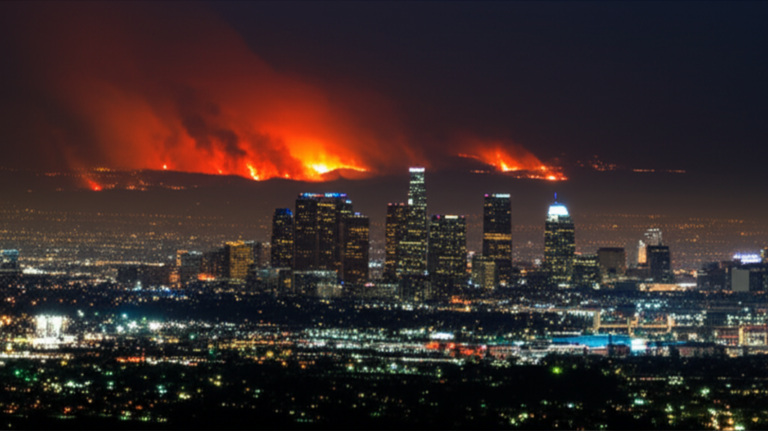
There was a peculiar kind of stillness the night the flames first broke out — one that felt less like calm and more like the hesitant pause before a cruel symphony began. Los Angeles, that sprawling metropolis of dreams and traffic jams, found itself cast into a fiery inferno that night as wildfires leapt from parched hills to urban edge like a puppeteer’s cruel puppet strings snapping loose all at once. The irony? The city known for its sun-soaked optimism and silver screen magic was humbled by flames that danced with a vengeance no Hollywood script could replicate.
It started quietly — a whisper of smoke on the horizon, a lonely ember catching dry brush like tinder on a winter’s hearth, except there was nothing warm or cozy about it. By midnight, the fire was a voracious beast, tearing through chaparral and homes alike, painting the sky in hues of blood and ash. Was it nature’s way of reminding humanity that beneath the concrete and neon, wilderness still lingers? Or, perhaps, it was a hellish counterpoint to L.A.’s relentless narrative of reinvention—the city trying to outrun its own fragile ecosystem.
The Night the City Caught Fire: Human Stories in the Ashes
Listening to survivors recount their flights from the fire’s fury is like piecing together a mosaic of chaos painted in urgency and resilience. One elderly woman, clutching a faded photo album, described waking to a “sky melting like candle wax,” a simile whose sweetness only deepened the tragedy of loss. Across town, a firefighter spoke of the firestorm as a “wild orchestra, furious and unpredictable, whose crescendo tore down homes as readily as it ripped through souls.”
On that night, more than 10,000 acres charred—an expanse larger than Manhattan. Evacuations swept through neighborhoods like a tidal wave, uprooting tens of thousands in a matter of hours. Yet, amid the panic, moments of absurdity emerged: a pet iguana escaped in the confusion, earning a quirky headline days later while the city continued to breathe deeply through a veil of smoke.
Nature’s Fury Versus Man’s Hubris: A Stark Contrast
Here lies a striking antithesis : Los Angeles, an emblem of human ingenuity and architectural marvel, lay vulnerable beneath skies painted by destruction, a stark reminder that human ambition and nature’s fury exist in a fragile dance. The sprawling freeway system—an epic network connecting millions—became funnel roads for evacuation, yet also prisons of molten air and choking ash. The very infrastructure designed to bind the city together turned momentarily into its own undoing.
Isn’t it haunting how the fire, like a liquid predator, ignored the lines drawn on maps, devouring forests and neighborhoods with the same merciless disregard? The golden hills, once shimmering like fleece under the California sun, were transformed into skeletal silhouettes—blackened ghosts against a smoke-swollen sky. The night felt like a burnt offering, a reminder of the fine edge L.A. walks between urban sprawl and wilderness.
Climate Change: The Fiery Backdrop No One Wanted to See
The wildfires were not an isolated incantation of destruction but part of a broader, bleeding narrative: the swelling crescendo of climate change. Years of drought, higher average temperatures, and altered wind patterns had turned California’s hills into kindling waiting for that fateful spark. It’s a cruel paradox—while the city sparkles with innovation and growth, its surrounding landscape is becoming increasingly fragile, highly susceptible to these pyromaniac seasons.
The winds that night were like a traitor’s breath, whipping the flames eastward with ferocious speed. Experts would later note that Santa Ana winds, notorious for accelerating wildfires, did exactly what they had done many times before, acting as the cruel enablers of destruction—invisible hands turning embers into raging dragons.
Evacuation and Emergency Response: A Chaotic Ballet of Survival
Emergency services scrambled to respond, but the scale was overwhelming. Firefighters fought not just flames but also the clock, traffic jams, and exhausted nerves. It is tempting to claim that technology and preparedness were on trial that night. Yet, the reality was more nuanced. Communications faltered. Families were separated. Evacuation centers overflowed. And while some viewed the crisis as confirmation of unpreparedness, others saw it as a tragic inevitability, a natural disaster making no distinction between wealth or poverty, privilege or anonymity.
Among the stories, a volunteer emergency nurse who had trekked for miles showed me a peculiar detail: a crumpled child’s drawing left behind on a doorstep. It depicted a smiling sun and a house untouched by fire—the kind of hope that stubbornly refuses to melt away, even as the real sun blazed against a sky darkened by smoke. Moments like these whisper that tragedy and hope are strange companions in this city of angels and ashes.
The Lingering Scars: Environmental and Psychological Impact
In the weeks and months following, the aftershocks rippled beyond charred landscapes. Ecological systems, not built for such intense bouts of fire, suffered long-term damage. Wildlife was displaced; soil erosion threatened watersheds. For humans, the trauma is less visible but no less profound. Many residents recount a lingering smell of fire, an olfactory scar that haunts their dreams. The night’s spectacle, once etched in fear, has decades stitched into collective memory.
And for a city obsessed with reinvention, the wildfires underscore a paradox: the quest for renewal sometimes arrives in the form of devastation. Like a forest that burns to bloom again, Los Angeles too must reckon with destruction as a prerequisite to growth—a delicate calculus few cities face with such frequency.
Could We Have Prevented It? Or Was It All Inevitable?
With hindsight casting its unforgiving light, one wonders whether this inferno was an accident—or a symptom of systemic oversight. Was the relentless spread of housing into brushland a reckless invitation to disaster? Did decades of forest management failures create the perfect tinderbox? Or was this simply a new, fiery chapter authored by a warming planet whose writing grows ever darker?
There is irony, subtle but sharp, in how the city’s sprawling ambition nudged it closer to nature’s threshold: a metropolis built on collaboration, yet one that had marginally prepared its wild edges for this kind of raw confrontation. The night’s flames burned not just landscapes but illusions—of control, of permanence. And perhaps that is the real fire Los Angeles must learn to extinguish.
The night the flames first erupted remains more than a date on a calendar; it lives on as a wailing siren echoing through the hills, a smoky fingerprint on the city’s soul. It’s a story not just about disaster but about resilience, vulnerability, and the humbling interplay between human ambition and nature’s indomitable power. And as California’s skies continue to darken on such nights, we might ask: how many more chapters will this volatile story write before the city learns to truly live with the fire it both fears and fuels? 🌲🔥🌁